
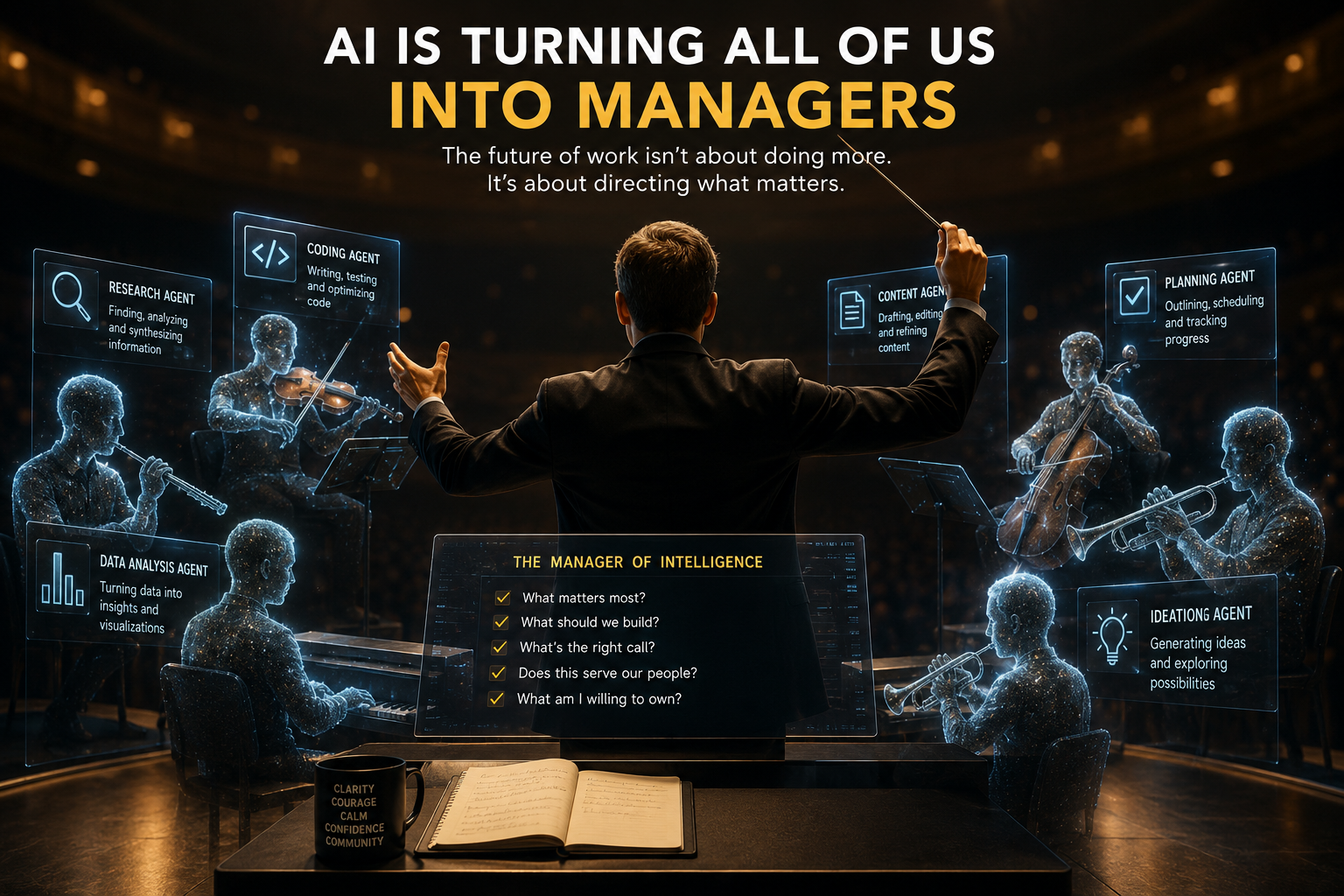
AI Is Turning All of Us Into Managers
You’re doing less of the work you were hired to do.
Not because you’re slacking. Because someone something else is doing it.
I noticed it first in a room full of software engineers. People who built careers writing code—except increasingly, they’re not writing all the code. They’re directing AI agents that write it.
Think about that shift.
Yesterday: do the work.
Today: direct intelligence that helps do the work.
And it isn’t confined to engineers.
I see it in my own business every week, where tasks that used to take hours now take minutes. My job is no longer to produce every piece of the work myself. It’s to determine what work needs doing, why it matters, what good looks like, and whether what comes back actually serves the goal.
That’s not producing.
That’s managing.
You’re becoming a manager of intelligence. So am I.
The Shift We Aren’t Talking About Enough
Most of us grew up in a world that rewarded doing.
Write the report. Analyze the spreadsheet. Build the presentation. Research the market. Produce the thing.
Master the task, become valuable.
But artificial intelligence is getting very good at the doing.
That doesn’t make people irrelevant. It moves where our value lives.
The question is no longer simply:
How much can I personally produce?
It’s increasingly:
How well can I direct intelligence, exercise judgment, make decisions, create meaning, and lead?
Which means more of us are being pushed into leadership.
Not the title.
The capacity.
My friend and fellow speaker Mike Evans recently pointed to a striking example of why this matters. Cisco reported record quarterly revenue—and at nearly the same time announced plans to eliminate thousands of jobs as it redirected resources toward areas it believes will drive its future.
Mike put it simply:
Growth and headcount used to move together. Now they don’t necessarily have to.
That’s worth sitting with.
For much of our working lives, organizational success offered at least some sense of individual security. If the company was growing and you were good at your job, you could reasonably believe there would be a place for you in what came next.
That bargain is changing.
Being great at the work your organization needed yesterday doesn’t guarantee that the same work—or even the same role—will be what it needs tomorrow.
Which makes the question more urgent:
If doing the task is no longer enough, what becomes uniquely ours to contribute?
AI Works Faster Than You. That’s the Point.
Here’s what I’ve noticed working alongside it:
It can overwhelm me.
I ask for five ideas and get fifty. I explore one strategic question and end up with twelve directions. I accomplish more in an afternoon than I used to in three days—and then discover I’ve manufactured more decisions than I know what to do with.
The machine doesn’t get tired.
I do.
So competing on speed is a losing proposition.
Something else is required.
Calm—the ability to regulate myself instead of letting the pace of technology set the pace of my nervous system.
Clarity—because when information becomes abundant, the scarce resource is knowing what actually matters. (That’s different from focus, by the way.)
Courage—because AI generates options. Someone still has to choose.
Confidence—because no model can guarantee that today’s decision works tomorrow.
Community—because more connectivity doesn’t automatically produce trust, belonging, or meaning.
Those are the Five C’s of Radical Adaptability™.
And here’s what the data says about where people actually get stuck.
Across my 2026 audiences, the most common survival pattern people identified wasn’t panic.
It was Confusion, at 29%.
Not too little information.
Too much of it, and no way to sort it.
As AI produces more information, more possibilities, and more options, that problem isn’t getting easier.
And notice what the Five C’s have in common.
They aren’t simply things you do.
They’re who you are while you’re doing.
Keeping Up Isn’t Enough
Most of the advice about adapting to AI sounds like this:
Learn the tools. Learn prompting. Learn agents. Automate your workflows. Get more productive.
Yes.
Do all of that. I am.
If the world is changing, refusing to learn the new tools isn’t wisdom.
It’s resistance in disguise.
But there’s a problem with making technical proficiency your entire adaptability strategy.
The tools won’t stop changing.
The platform you master this year gets eclipsed. The workflow you perfect gets automated. The task that makes you valuable today may eventually cost pennies for a machine to perform.
The durable move is older than the technology.

In 2005, IBM completed the sale of its personal computer business to Lenovo. Think about what that meant: IBM was walking away from the product category that had helped make the company a household name.
The PC business wasn’t irrelevant. It simply no longer fit where IBM believed it was going.
When the deal was announced, CEO Sam Palmisano told employees that IBM’s business model required the company to continually reinvent its technologies, products, services, culture—even its portfolio of businesses.
That’s Radical Adaptability.
IBM didn’t survive decades of technological upheaval by protecting everything that had once made it successful. It repeatedly had to decide what still belonged in the future—and what didn’t.
So learn the technology.
Then make the bigger investment:
In the human being who has to navigate whatever comes after it.
That’s Radical Adaptability.
It doesn’t ask:
How do I keep up?
It asks:
Who do I need to become?
This Ends Now
There’s a belief a lot of us need to leave behind:
My value comes from how much work I can personally do.
That belief earned its keep.
For decades, output was a competitive advantage. Doing more, faster, often made you more valuable.
But when you’re working alongside intelligence that produces in seconds what takes you hours, trying to win the doing contest becomes increasingly absurd.
This isn’t a case for working less.
Craftsmanship still matters.
And we absolutely do not outsource our thinking.
It’s that our relationship to the work has changed.
So this ends now:
The assumption that you have to do everything yourself to be valuable.
The belief that your professional value is measured primarily by your output.
The idea that staying relevant means getting faster at tasks you already know how to perform.
Let them go.
Something else is required.
This Moment Matters
Think of yourself as a leader.
Today.
Even if nobody reports to you.
Because your work is increasingly to answer questions no model can answer for you:
What actually matters here?
What problem are we really solving?
What should technology do—and what should stay human?
Is this output correct? And is it wise?
Does it serve the people we’re trying to serve?
What deserves my attention?
What decision am I willing to own?
Those are leadership questions.
And the more powerful the tools become, the more important the person directing them becomes.
So if I were making one bet on my own future, it wouldn’t be on getting better at a task technology is learning to do.
I’d get exceptionally good at being human.
At regulating myself under pressure.
At telling signal from noise.
At making hard calls.
At moving without certainty.
At earning trust.
At building connection.
At asking better questions.
At determining not simply what can be done, but what should be done.
AI will keep getting better at being AI.
We don’t need to beat it at that.
Our work is to get better at being human.
Up we go—

Shawn Ellis is a keynote speaker and creator of Radical Adaptability™. He helps leaders and teams build the human capabilities to thrive through relentless change. If your organization is navigating AI, restructuring, transformation—or any change that’s asking people to work differently than they have before—let’s talk.